Research Article - Archives of Applied Science Research ( 2025) Volume 17, Issue 1
Received: 23-Aug-2024, Manuscript No. AASR-24-146228; Editor assigned: 26-Aug-2024, Pre QC No. AASR-24-146228 (PQ); Reviewed: 09-Sep-2024, QC No. AASR-24-146228; Revised: 09-Feb-2025, Manuscript No. AASR-24-146228 (R); Published: 16-Feb-2025
The recognisable faulting regime at the southern half of the 8 km2 Phase II Development, Gidan Kwano Campus, is the vestigial northeast-southwest cross-country lineament that defines the Kazaure-Karaukarau-Kushaka-Ilesha Schist Belt. This belt of schist lithology of circa 800 m width and some 700 km length is “sandwiched” between a dominant granite mass to the northwest and southeast with some prominent showing of gneissic rock-mass at this southeast plain. A route of inquiry as part of the endeavour to create a purpose-specific corpus of geo-centric information for the Phase II Development leads to the question of the presence of continuous east-west or west-east faulting regimes as subordinate zones of permeation within the main NE-SW-trending lineament. The aforementioned “route of inquiry” centred on validating the conclusion drawn with respect to the hydro-centric nature of neighbouring principal survey stations along the 12th cross-profile of the half-scale 4 km2 areal extent that is the southern Phase II Development. Whilst a core vertical electrical sounding study at this half-scale 4 km2 areal extent placed stringent constraint on conclusions that can be reached on hydro-centric prospects, it is observed that it is within the realm of plausibility that a 2000 m length of west-east faulting signature traverses the 12th cross-profile. It is thus recommended that a suite of constant separation traverse and very low-frequency electromagnetic survey be carried out along the 12th cross-profile to test if this is a “wet” fault-line for its entire west-east length. Also, series of corresponding cross-profiles north and south of the 12th cross-profile should be investigated in the format that is posited.
Fault, Cross-profile, Vestige, Lineament, Schist, Geo-centric, Permeation, Hydro-centric
It has been posited that the major faulting regime that traverses the Gidan Kwano Campus Phase II Development is a Northeast-Southwest (NE-SW) trending lineament [1]. This NE-SW lineament actually corresponds to the vestige of the once-prominent Kazaure-Karaukarau-Kushaka-Ilesha Schist Belt [2]. The pattern of this lineament can be made out in Figure 1, as culled from the result of the interpretation of resistivity data acquired in transverse traverse format at the southern 4 km2 half of the 8 km2 Gidan Kwano Campus Phase II Development [3].
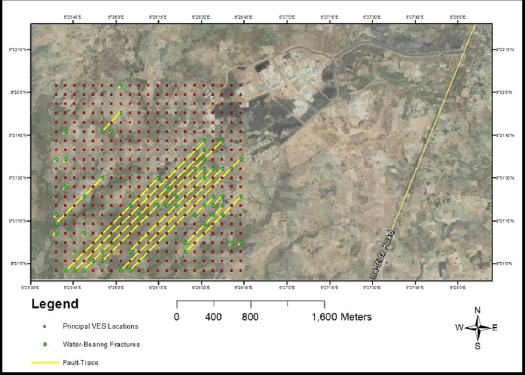
Figure 1. Fault-trace of fracture signatures on the satellite imagery map of the southern 4 km2 half of the 8 km2 Gidan Kwano Campus Phase II Development with the developed phase I in the background to the northeast.
The trace of the Kazaure-Karaukarau-Kushaka-Ilesha Schist Belt plotted on the map of Nigeria is as shown in Figure 2 [4]. The segment of this NE-SW lineament cutting through the southern reaches of the 8 km2 Phase II Development (Figure 1), which was serendipitously determined, has been colloquially named “Jonah,” thus aptly coined to honour S.A. Jonah.
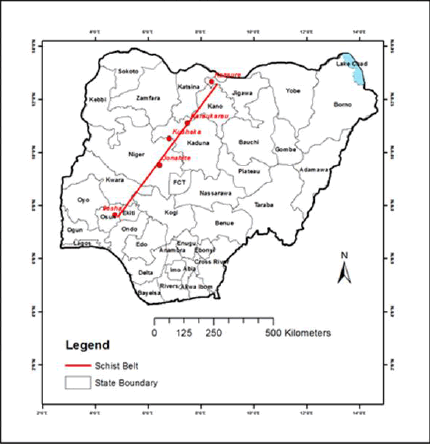
Figure 2. The NE-SW line drawn from the Kazaure schist body through to the Ilesha schist body.
The grid-schedule of the principal survey stations at the 4 km2 for the Vertical Electrical Sounding (VES) survey of Jonah and Olasehinde and its complementary Induced Polarisation (IP) data-acquisition scheme is as shown in Figure 3.
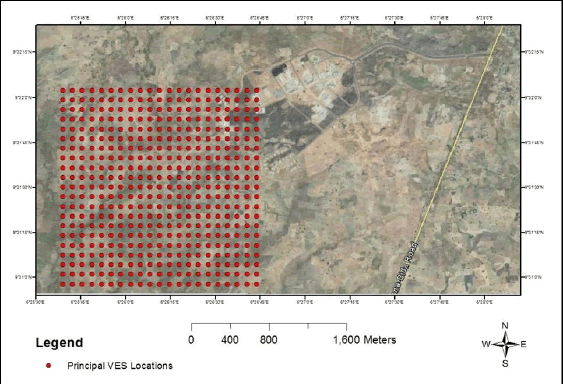
Figure 3. Grid-schedule of the half-segment 4 km2 Southern Phase II Development shown against a background of the satellite image of the built-up Phase I Development. (The yellow-coloured linear slope seen to the east of the 4 km2 grid is the Minna-Bida Road.)
The westernmost south-north or north-south or Longitudinal Traverse (LT) profile line represented by the series of twentyone red dots, each at 100 m separation, can be made out in Figure 3 [5]. There are thus 21 such LT profiles as well as 21 cross-profiles or Transverse Traverses (TTs) in the schedule of Figure 3 for the 2 km by 2 km grid [6]. The TTs designation is from south to north as are the principal survey station designations, such that P1-1 say, is the southwestern reddest dot of Figure 3 [7].
Water-bearing fracture signatures
The water-bearing fracture signatures inferred from a combination of the geoelectric cross-sections and the induced polarisation tables (in qualitative validation mode), as can be made out in Figure 1 are presented hence:
Along the First North-South Profile (P1):
P1-5 (09°31′10.76′′; 006°25′39.00′′)
P1-6 (09°31′14.00′′; 006°25′39.00′′)
P1-7 (09°31′17.24′′; 006°25′39.00′′)
P1-13 (09°31′36.66′′; 006°25′39.00′′)
Along the Second North-South Profile (P2):
P2-1 (09°30′57.80′′;006°25′42.24′′)
P2-10 (09°31′26.96′′; 006°25′42.24′′)
P2-13 (09°31′36.66′′; 006°25′42.24′′)
P2-16 (09°31′46.38′′; 006°25′42.24′′)
Along the Third North-South Profile (P3):
P3-1 (09°30′57.80′′; 006°25′45.48′′)
P3-3 (09°31′04.28′′; 006°25′45.48′′)
Along the Fourth North-South Profile (P4):
P4-1 (09°30′57.80′′; 006°25′48.72′′)
P4-5 (09°31′10.76′′; 006°25′48.72′′)
P4-9 (09°31′23.72′′; 006°25′48.72′′)
Along the Fifth North-South Profile (P5):
P5-2 (09°31′01.04′′; 006°25′51.96′′)
Along the Sixth North-South Profile (P6):
P6-2 (09°31′01.04′′; 006°25′55.20′′)
P6-3 (09°31′04.28′′; 006°25′55.20′′)
P6-11 (09°31′30.18′′; 006°25′55.20′′)
P6-16 (09°31′46.38′′; 006°25′55.20′′)
Along the Seventh North-South Profile (P7):
P7-16 (09°31′14.00′′; 006°25′58.44′′)
Along the Eight North-South Profile (P8):
P8-1 (09°30′57.80′′; 006°26′01.68′′)
P8-18 (09°31′52.86′′; 006°26′01.68′′)
P8-21 (09°32′02.58′′; 006°26′01.68′′)
Along the Ninth North-South Profile (P9):
P9-1 (09°30′57.80′′; 006°26′04.92′′)
P9-3 (09°31′04.28′′; 006°26′04.92′′)
P9-8 (09°31′20.48′′; 006°26′04.92′′)
Along the Tenth North-South Profile (P10):
P10-7 (09°31′17.24′′; 006°26′08.16′′)
Along the Twelfth North-South Profile (P12):
P12-8 (09°31′20.48′′; 006°26′14.64′′)
P12-11 (09°31′30.18′′; 006°26′14.64′′)
Along the Thirteenth North-South Profile (P13):
P13-8 (09°31′20.48′′; 006°26′17.88′′)
P13-10 (09°31′26.96′′; 006°26′17.88′′)
Along the Fourteenth North-South Profile (P14):
P14-8 (09°31′20.48′′; 006°26′21.12′′)
P14-9 (09°31′23.72′′; 006°26′21.12′′)
Along the Fifteenth North-South Profile (P15):
P15-3 (09°31′04.28′′; 006°26′24.36′′)
P15-4 (09°31′07.52′′; 006°26′24.36′′)
Along the Sixteenth North-South Profile (P16):
P16-7 (09°31′17.24′′; 006°26′27.60′′)
P16-12 (09°31′33.42′′; 006°26′27.60′′)
Along the Seventeenth North-South Profile (P17):
P17-6 (09°31′14.00′′; 006°26′30.84′′)
P17-8 (09°31′20.48′′; 006°26′30.84′′)
P17-11 (09°31′30.18′′; 006°26′30.84′′)
P17-12 (09°31′33.42′′; 006°26′30.84′′)
P17-13 (09°31′36.66′′; 006°26′30.84′′)
P17-14 (09°31′39.90′′; 006°26′30.84′′)
P17-15 (09°31′43.14′′; 006°26′30.84′′)
Along the Eighteenth North-South Profile (P18):
P18-7 (09°31′17.24′′; 006°26′34.08′′)
P18-8 (09°31′20.48′′; 006°26′34.08′′)
P18-9 (09°31′23.72′′; 006°26′34.08′′)
P18-12 (09°31′33.42′′; 006°26′34.08′′)
Along the Nineteenth North-South Profile (P19):
P19-7 (09°31′17.24′′; 006°26′37.32′′)
P19-8 (09°31′20.48′′; 006°26′37.32′′)
P19-9 (09°31′23.72′′; 006°26′37.32′′)
P19-12 (09°31′33.42′′; 006°26′37.32′′)
P19-15 (09°31′43.14′′; 006°26′37.32′′)
Along the Twentieth North-South Profile (P20):
P20-4 (09°31′07.52′′; 006°26′40.56′′)
P20-12 (09°31′33.42′′; 006°26′40.56′′)
Along the Twenty-first North-South Profile (P21):
P21-4 (09°31′07.52′′; 006°26′43.80′′)
P21-9 (09°31′23.72′′; 006°26′43.80′′)
P21-13 (09°31′36.66′′; 006°26′43.80′′)
Observations along TT 12
In the course of the data-processing schedule for the Jonah and Olasehinde study, VES TT survey data was not acquired at P10-12 during the 2014 survey year because data was collected in the LT mode at P10-12 during the 2011 survey year [8]. The thinking back then was data-fields acquired in the LT and TT modes could be processed as a corpus of geoelectrical data-sets irrespective of the direction of survey. However, this planned protocol was jettisoned during the data-processing stage proper. Thus, the work of Jonah and Olasehinde makes no empirical deduction regarding P10-12. Examine the format in which Table 1 for P10-12 was presented in the Jonah and Olasehinde study. In the study of Jonah, the fortuitouslyacquired LT VES data at P10-12 was used to validate the hydro-centric deduction drawn with respect to the groundwaterprospect location of LT P11-12 as enunciated in Jonah and Jimoh. Thus, a continuous fracture regime at depth exists between P10-12 and P11-12, one that was not enunciated in the work of Jonah and Olasehinde as a result of “null data-set” circumstance, so to say.
| AB/2 (m) | MN/2 (m) | Geom. Factor, K | Resistance | Standard deviation | Current (I) | Stacks | Resistivity (Ωm) |
| 1 | 0.5 | 2.36 | DATA | EXISTS | IN | LT | FORMAT |
| 2 | 0.5 | 11.8 | DATA | EXISTS | IN | LT | FORMAT |
| 3 | 0.5 | 27.8 | DATA | EXISTS | IN | LT | FORMAT |
| 5 | 0.5 | 77.8 | DATA | EXISTS | IN | LT | FORMAT |
| 6 | 0.5 | 112 | DATA | EXISTS | IN | LT | FORMAT |
| 6 | 1 | 55 | DATA | EXISTS | IN | LT | FORMAT |
| 8 | 1 | 99 | DATA | EXISTS | IN | LT | FORMAT |
| 10 | 1 | 156 | DATA | EXISTS | IN | LT | FORMAT |
| 10 | 2.5 | 58.9 | DATA | EXISTS | IN | LT | FORMAT |
| 15 | 2.5 | 137 | DATA | EXISTS | IN | LT | FORMAT |
| 20 | 2.5 | 245 | DATA | EXISTS | IN | LT | FORMAT |
| 30 | 2.5 | 562 | DATA | EXISTS | IN | LT | FORMAT |
| 40 | 2.5 | 1001 | DATA | EXISTS | IN | LT | FORMAT |
| 40 | 7.5 | 323 | DATA | EXISTS | IN | LT | FORMAT |
| 50 | 7.5 | 512 | DATA | EXISTS | IN | LT | FORMAT |
| 60 | 7.5 | 742 | DATA | EXISTS | IN | LT | FORMAT |
| 70 | 7.5 | 1014 | DATA | EXISTS | IN | LT | FORMAT |
| 80 | 7.5 | 1329 | DATA | EXISTS | IN | LT | FORMAT |
| 80 | 15 | 647 | DATA | EXISTS | IN | LT | FORMAT |
| 90 | 15 | 825 | DATA | EXISTS | IN | LT | FORMAT |
| 100 | 15 | 1024 | DATA | EXISTS | IN | LT | FORMAT |
Table 1. Format of presentation of VES non-acquisition schedule at P10-12.
It was pointed out in the work of Jonah that P12-12 was nonetheless an encouraging groundwater-prospect location even if this location was not domiciled amongst the final list of Sec.2.0 upon applying stringent IP validation procedure. Thus, a continuous fracture regime at depth exists between P10-12 and P11-12 and this extends to P12-12. P10-12 is exactly 100 m west of P11-12 along the straight west-east line of the 12th TT and P11-12 is exactly 100 m west of P12-12 along the straight west-east line of the 12th TT. Obviously, a continuous 200-m fracture regime can be traced along TT12 within the width of the localised vestige of the Kazaure-Karaukarau-Kushaka-Ilesha Schist Belt traversing the southern reaches of the Gidan Kwano Phase II Development. This can be made out in Figure 1. Based on the stringent IP validation procedure applied to groundwater-prospect locations so that these become classified as “hydro-centric” in the work of Jonah and Olasehinde, the next TT location on a straight line 100 m east of P12-12 (that is, P13-12) was not flagged as “hydro-centric” even though an examination of Table 2 indicates that P13-12 is a seeming groundwater-prospect location. Thus, now, a continuous 300- m fracture regime can be traced along TT12 within the width of the localised vestige of the Kazaure-Karaukarau-KushakaIlesha Schist Belt traversing the southern reaches of the Gidan Kwano Phase II Development. It can be gleaned from the information presented in Sec.2.0 that P14-12 and P15-12 are not flagged as “hydro-centric” even though the corpus of the tables of “raw” VES survey data-fields of the Jonah and Olasehinde work indicates that P14-12 and P15-12 are both characterised by fractures at depths. However, it is seen from Sec.2.0 that P16-12 is flagged as “hydro-centric;” ditto P17- 12, P18-12, P19-12, and P20-12. Station P21-12 was not flagged as “hydro-centric” in Sec.2.0, but as Table 3 shows, this location is an encouraging groundwater prospect in the absence of the aforementioned stringent IP validation scheme. It is thus within the realm of plausibility, based on the analysis so far, that a west-east faulting regime traverses TT12 from P10- 12 to P21-12, a length of 1100 m.
Now, the point of P9-12, 100 m west of P10-12 and located within the width of the vestige of the Kazaure-KaraukarauKushaka-Ilesha Schist Belt as made out in Figure 1, is a seeming groundwater-prospect even though this location was not tagged “hydro-centric” in the Jonah and Olasehinde study. Data was not acquired at P8-12, 100 m west of P10-12 and located just inside the width of the vestige of the Kazaure-Karaukarau-Kushaka-Ilesha Schist Belt, because of “wet-seasonal stream” natural barrier at the time of survey. P7-12, just on the edge of the width of the vestige of the Kazaure-KaraukarauKushaka-Ilesha Schist Belt, is a seeming groundwater prospect that was not flagged as “hydro-centric” by Jonah and Olasehinde. Stations P1-12 to P6-12 indicate low-resistivity, seemingly water-filled fracturing characters at depth but these did not qualify as “hydro-centric” by the stringent IP elimination scheme of Jonah and Olasehinde. Thus, a west-east faulting regime traverses TT12 from P1-12 to P21-12, a length of 2000 m.
It is thus recommended that a suite of constant separation traversing and very low-frequency electromagnetic survey be carried out along the 12th cross-profile to test if this is a “wet” fault-line for its entire west-east length. Also, series of corresponding cross-profiles north and south of the 12th cross-profile should be investigated in the format that is posited (Tables 2 and 3).
| AB/2 | MN/2 | Geom. Factor, K | Resistance | Standard deviation | Current (I) | Stacks | Resistivity |
| 1 | 0.5 | 2.36 | 32.617 Ω | 0 | 100 mA | 2 | 76.976 |
| 2 | 0.5 | 11.8 | 3.0968 Ω | 0.01 | 100 mA | 4 | 36.542 |
| 3 | 0.5 | 27.8 | 1.0126 Ω | 0.04 | 100 mA | 4 | 28.15 |
| 5 | 0.5 | 77.8 | 410.93 mΩ | 0.12 | 100 mA | 4 | 31.97 |
| 6 | 0.5 | 112 | 324.76 mΩ | 0.11 | 100 mA | 4 | 36.373 |
| 6 | 1 | 55 | 560.08 mΩ | 0.62 | 100 mA | 4 | 30.804 |
| 8 | 1 | 99 | 168.02 mΩ | 0.02 | 100 mA | 4 | 16.633 |
| 10 | 1 | 156 | 127.51 mΩ | 0.01 | 100 mA | 4 | 19.891 |
| 10 | 2.5 | 58.9 | 283.46 mΩ | 3.1 | 100 mA | 4 | 16.695 |
| 15 | 2.5 | 137 | 175.95 mΩ | 0.5 | 100 mA | 4 | 24.105 |
| 20 | 2.5 | 245 | 153.81 mΩ | 0.84 | 100 mA | 4 | 37.683 |
| 30 | 2.5 | 562 | 198.66 mΩ | 0.01 | 100 mA | 4 | 111.64 |
| 40 | 2.5 | 1001 | 285.20 mΩ | 0 | 100 mA | 2 | 285.48 |
| 40 | 7.5 | 323 | 625.97 mΩ | 0.63 | 100 mA | 4 | 202.18 |
| 50 | 7.5 | 512 | 227.78 mΩ | 0 | 100 mA | 4 | 116.62 |
| 60 | 7.5 | 742 | 205.72 mΩ | 0.02 | 100 mA | 4 | 152.64 |
| 70 | 7.5 | 1014 | 154.78 mΩ | 0.02 | 100 mA | 4 | 156.94 |
| 80 | 7.5 | 1329 | 215.66 mΩ | 0.02 | 100 mA | 4 | 286.61 |
| 80 | 15 | 647 | 213.05 mΩ | 0.01 | 100 mA | 4 | 137.84 |
| 90 | 15 | 825 | 572.25 mΩ | 0.46 | 100 mA | 4 | 472.1 |
| 100 | 15 | 1024 | 490.13 mΩ | 0.41 | 100 mA | 4 | 501.89 |
Table 2. VES acquisition result at P13-12.
| AB/2 | MN/2 | Geom. Factor, K | Resistance | Standard deviation | Current (I) | Stacks | Resistivity |
| 1 | 0.5 | 2.36 | 15.043 Ω | 0.01 | 100 mA | 4 | 35.501 |
| 2 | 0.5 | 11.8 | 2.2531 Ω | 0.04 | 100 mA | 4 | 26.586 |
| 3 | 0.5 | 27.8 | 825.50 mΩ | 0.47 | 100 mA | 4 | 22.948 |
| 5 | 0.5 | 77.8 | 402.29 mΩ | 0.33 | 100 mA | 4 | 31.298 |
| 6 | 0.5 | 112 | 251.22 mΩ | 0.19 | 100 mA | 4 | 28.136 |
| 6 | 1 | 55 | 731.33 mΩ | 0.82 | 100 mA | 4 | 40.223 |
| 8 | 1 | 99 | 528.57 mΩ | 0.11 | 100 mA | 4 | 52.328 |
| 10 | 1 | 156 | 417.33 mΩ | 0.1 | 100 mA | 4 | 65.103 |
| 10 | 2.5 | 58.9 | 1.0951 Ω | 0.18 | 100 mA | 4 | 64.501 |
| 15 | 2.5 | 137 | 667.51 mΩ | 0.11 | 100 mA | 4 | 91.448 |
| 20 | 2.5 | 245 | 464.83 mΩ | 0.14 | 100 mA | 4 | 113.88 |
| 30 | 2.5 | 562 | 284.63 mΩ | 0.22 | 100 mA | 4 | 159.96 |
| 40 | 2.5 | 1001 | 212.96 mΩ | 0.15 | 100 mA | 4 | 213.17 |
| 40 | 7.5 | 323 | 1.0426 Ω | 0.16 | 100 mA | 4 | 336.75 |
| 50 | 7.5 | 512 | 2.5216 Ω | 0.01 | 100 mA | 2 | 1291 |
| 60 | 7.5 | 742 | 1.9651 Ω | 0.16 | 100 mA | 4 | 1458.1 |
| 70 | 7.5 | 1014 | 2.1272 Ω | 0.09 | 100 mA | 4 | 2156.9 |
| 80 | 7.5 | 1329 | 3.5481 Ω | 0 | 100 mA | 2 | 4715.4 |
| 80 | 15 | 647 | 657.41 mΩ | 0.55 | 100 mA | 4 | 425.34 |
| 90 | 15 | 825 | 581.33 mΩ | 0.19 | 100 mA | 4 | 479.59 |
| 100 | 15 | 1024 | 541.91 mΩ | 0.15 | 100 mA | 4 | 554.91 |
Table 3. VES acquisition result at P21-12.
The investigation of the Gidan Kwano Phase II Development reveals compelling evidence of a continuous west-east faulting regime along the 12th Transverse Traverse (TT12), embedded within the vestigial Kazaure-Karaukarau-Kushaka-Ilesha Schist Belt. Through the synthesis of geoelectrical data, induced polarization analysis, and historical resistivity profiles, a strong case emerges for the presence of an approximately 2000 m long fault signature exhibiting significant hydro-centric potential, particularly between P10-12 and P20-12. Despite limitations from incomplete data acquisition at certain points and the stringent criteria for hydro-centric classification, the broader fracture pattern suggests the plausibility of a "wet" fault-line extending across TT12. This interpretation supports the need for further high-resolution geophysical surveys specifically constant separation traverses and Very Low-Frequency Electromagnetic (VLF-EM) methods to confirm groundwater potential and delineate subsurface continuity. Additionally, adjacent transverse profiles north and south of TT12 warrant detailed investigation to map the lateral extent and hydrogeological significance of this faulting regime. These findings could play a pivotal role in guiding future groundwater resource development and land-use planning within the campus.